Long Distance Movers NYC: Challenges and Solutions for Commercial Relocations
Moving a 50,000-square-foot financial services firm from Midtown Manhattan to another city isn't a logistics problem; it's a commercial moving project management problem. For companies searching for reliable long-distance movers NYC enterprises trust, the gap between a general carrier and a purpose-built commercial relocation partner becomes apparent fast. Hudson River Moving & Storage, based at 501 Windsor Dr., Secaucus, NJ 07094, has managed this category of work since 2010, from multi-floor Manhattan office cutovers to complex interstate relocations involving IT infrastructure, high-value FF&E, and zero tolerance for downtime. This guide covers the real operational challenges of long-distance commercial moves originating from New York City, and the proven solutions that separate a smooth transition from a costly one.
Why Long Distance Commercial Moves from NYC Demand Specialized Long Distance Movers
New York City creates a set of starting conditions that make commercial moves more operationally demanding than comparable moves in virtually any other U.S. market. That's not hyperbole; it's a function of density, building regulation, and logistics infrastructure that any experienced facilities manager already knows firsthand.
The NYC Starting-Point Problem
Before a single piece of equipment leaves the floor, your team is negotiating freight elevator reservation windows, satisfying building management certificate-of-insurance requirements, and scheduling loading dock access in some of the most congested corridors in the country. Midtown and Lower Manhattan buildings often designate specific freight elevator operating windows after normal business hours. Coordinating these access periods in advance is essential to keeping commercial relocations on schedule and minimizing business disruptions.
Permit coordination, building management approvals, and COI submissions in NYC require advance lead time that a general long-haul carrier isn't structured to manage.
What "Long Distance" Actually Means for a Commercial Move
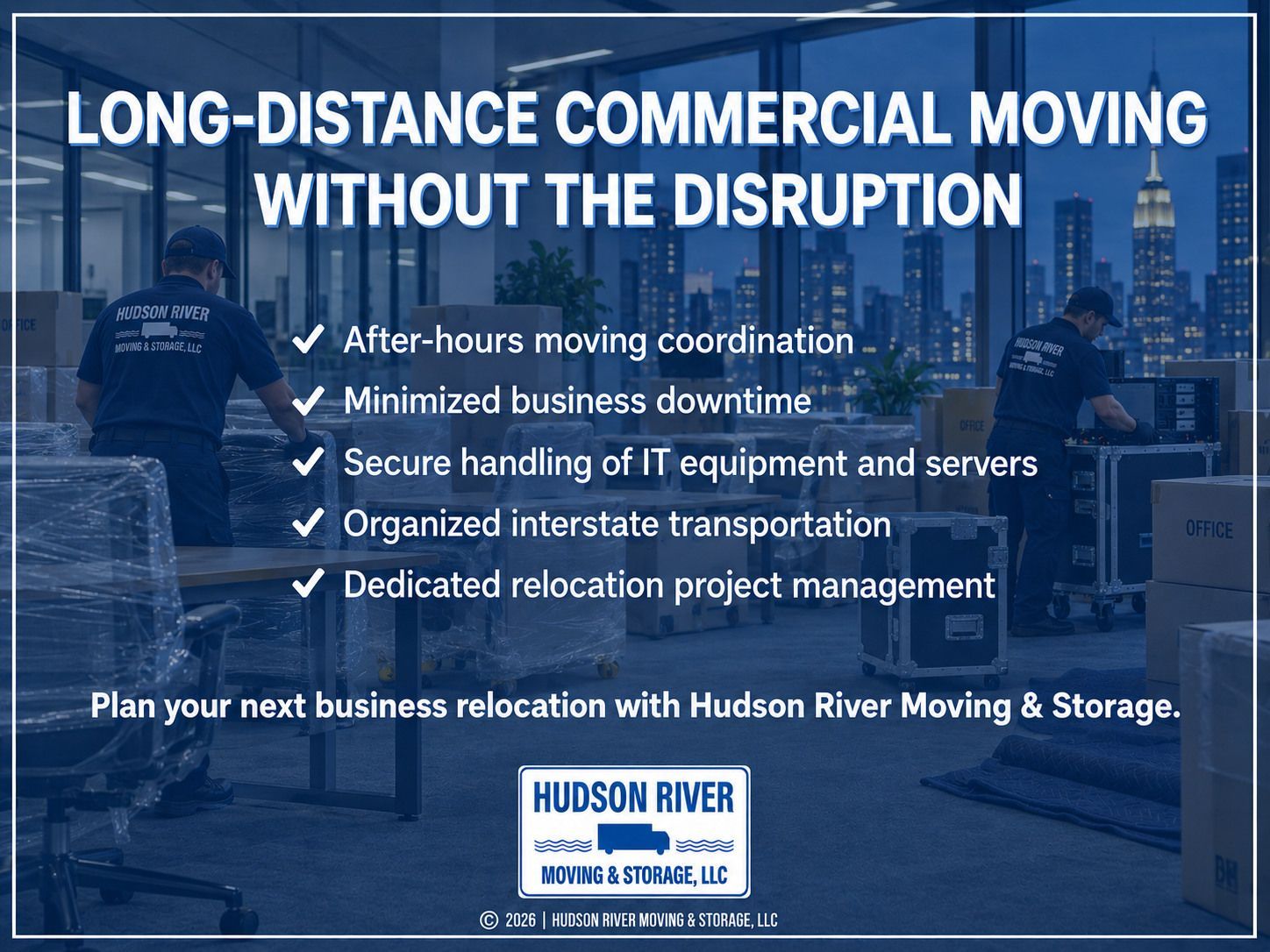
In the enterprise context, long distance isn't simply about mileage. It means jurisdictional change, multi-stop sequencing, phased transitions between facilities, and destination-side coordination in a city where your moving partner may not have daily relationships. It means DOT classifications, interstate cargo compliance, and asset accountability across a chain of custody that can span several days.
This is categorically different from residential long distance. The benchmark here isn't delivering boxes to a new home; it's having servers reconnected, workstations staged, and employees fully operational by Monday morning.
Core Challenges in Long-Distance Office Relocation
Ask any corporate facilities manager who has survived a botched office relocation what went wrong, and you'll hear variations of the same three answers. Each one maps directly to a solvable problem if the right structure is in place before the trucks are loaded.
Downtime Windows Are Non-Negotiable
NYC-based enterprises typically execute moves over a single weekend cutover. The expectation is Monday-morning operational readiness, employees at their desks, IT systems online, phones answered. Long distance adds transit time that must be engineered into the window from the project plan stage, not improvised during execution.
When that planning doesn't happen, the consequences are concrete: IT systems go dark past the deadline, employees sit idle, and client-facing operations stall. Weekend cutovers for long-distance moves require a level of disassembly sequencing, transport, transit staging, and destination-side preparation that only a project-managed operation can reliably deliver.
Multi-Jurisdictional Compliance and Vendor Coordination
Interstate commercial moves cross DOT jurisdictions. Cargo must be appropriately classified and insured under applicable federal and state frameworks. On the destination side, your mover must coordinate loading dock access, building management COI submissions, and elevator reservations in an unfamiliar city—often weeks in advance of the actual move date.
Union labor rules may also differ between origin and destination markets. A commercial mover without interstate operational experience will encounter these variables during execution rather than before it. That's when delays become expensive.
Asset Protection Over Distance
High-value FF&E, IT infrastructure, and art face measurably greater exposure over long hauls than in local moves. Temperature and humidity shifts during transit pose a genuine risk to archival materials, certain art media, and sensitive electronics. Vibration and road conditions over hundreds of miles require different packaging protocols than a cross-town move.
Hudson River Moving & Storage’s IT relocation capability and specialty handling services, including climate-controlled storage across more than 200,000 square feet, are designed specifically for asset profiles that can't absorb transit damage.
How Project Management Solves the Coordination Problem
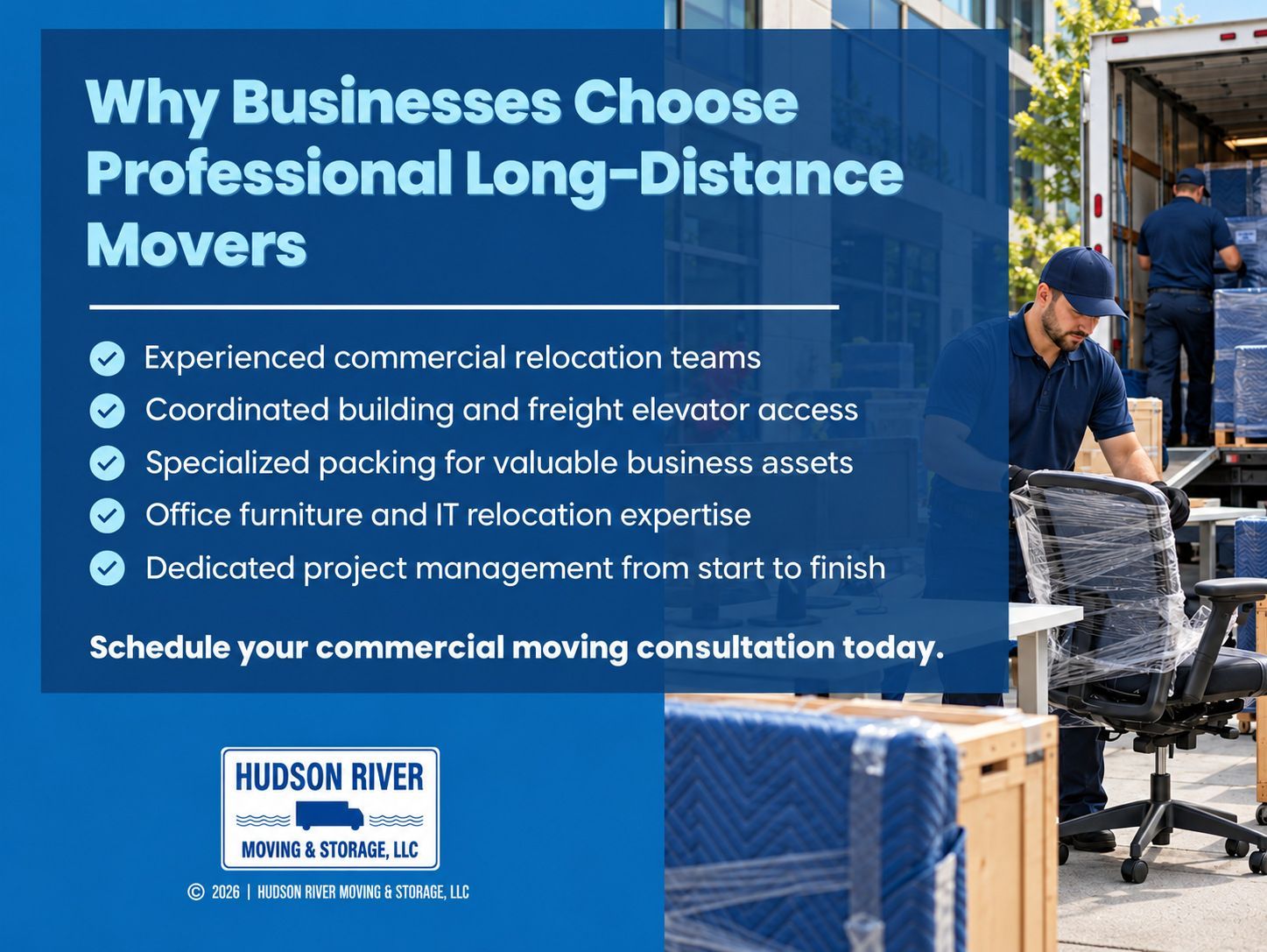
The single most common failure point in long-distance commercial moves isn't the move itself; it's the coordination gap between origin, transit, and destination. Multiple vendors, multiple building contacts, and multiple timelines collide without a single accountable owner. That's exactly what a dedicated project manager resolves.
One Accountable Contact Across Two Cities
At Hudson River Moving & Storage, every engagement, regardless of scope or distance, is assigned a dedicated project manager from kickoff through post-move close-out. Not a dispatcher who routes calls—an actual coordinator who owns the outcome.
That PM manages NYC building access coordination, destination-side facility contacts, the IT team's disconnect-and-reconnect schedule, and FF&E inventory accountability. When something changes—and something always changes—there's one person who knows the full picture and has the authority to adjust.
This is why organizations like Wells Fargo, Deutsche Bank, Moody's, and the NYSE have trusted Hudson River Moving & Storage with high-stakes commercial relocations. The project management model scales to the complexity of their operations without adding layers of communication overhead that create risk.
The Hudson River Moving & Storage Project Process
Every engagement follows a structured sequence:
- In-person walk-through at the origin facility to assess asset inventory, building access parameters, and IT scope
- Custom project plan development with the client's facilities, IT, and operations teams
- Dedicated PM assignment as the single point of contact from kickoff forward
- Destination-side advance coordination—building management, COIs, dock reservations, local vendor relationships
- Execution and post-move close-out with PM oversight through completion
IT Relocation and FF&E Across State Lines
Technology infrastructure is the highest-stakes element of any commercial relocation. In a long-distance move, the margin for error is even smaller. Transit time means IT systems are offline longer, and reconnection happens in a new city where your team's physical presence may be limited.
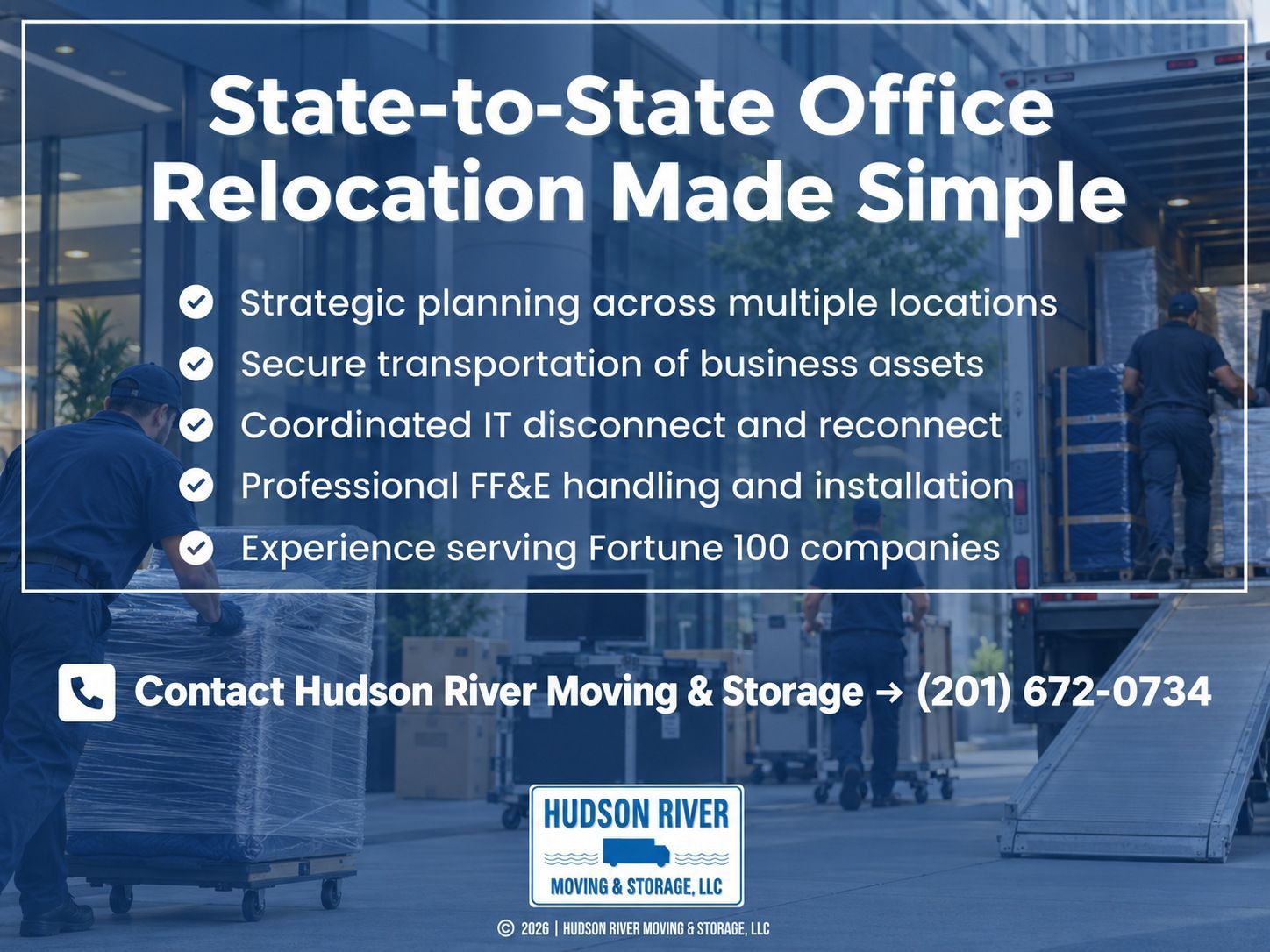
Hudson River Moving & Storage handles IT relocation end-to-end: disconnect, pack, transport, reconnect, and validate. Servers, networking hardware, workstations, and AV systems are inventoried, packed to transit-specific standards, transported in accordance with appropriate cargo protocols, and reconnected at the destination by the technicians who documented the original configuration.
FF&E coordination across state lines requires the same discipline. Furniture systems must be disassembled, labeled, transported, and reassembled according to the destination floor plan—not improvised upon arrival. For clients with complex workstation configurations or branded interior environments, this is a precision operation, not a moving job.
How Commercial Movers in NYC Handle Long-Distance Logistics
What does execution actually look like for a company like Hudson River Moving & Storage on a long-distance commercial project? The key operational differences from a local move include:
- Phased asset staging at the 200,000+ sq ft climate-controlled facility, allowing origin-side packing to complete before transit begins.
- Dedicated long-haul transport with appropriate commercial cargo classification and insurance.
- Destination-side advance teams to prep receiving areas, confirm building access, and coordinate local labor where required.
- Real-time communication through the dedicated PM so the client always knows where assets are in the chain of custody
According to the International Facility Management Association (IFMA), unplanned downtime during office relocations is one of the top operational risks facing corporate facilities teams—a finding consistent with what Hudson River Moving & Storage's clients report before they engage a project-managed partner.
Frequently Asked Questions: Long-Distance Commercial Moving from NYC
What are the most common challenges in long-distance commercial moves?
The three most consistent challenges are downtime window management, multi-jurisdictional compliance, and asset protection over distance. Long-distance moves require more advanced coordination than local relocations. Building access at both origin and destination, interstate cargo classification, and destination-side vendor relationships all need to be locked in before the move begins. Without a dedicated project manager owning these variables, gaps emerge during execution, and delays follow.
How Can NYC Movers Ensure Safe and Timely Long-Distance Relocations?
Safe and timely long-distance commercial relocations depend on three things: a project manager who owns the outcome end-to-end, purpose-built IT and FF&E handling protocols that account for transit conditions, and destination-side coordination that begins weeks before the move date. Call Hudson River Moving & Storage at (201) 672-0734. If email is easier for you, feel free to head over to our contact page and fill out the information form there.
