Climate-Controlled Moving and Storage Solutions for State-to-State Relocations
When your business faces a multi-state relocation, the margin for error shrinks to nearly zero. Equipment damage during transit, IT systems that fail to reconnect, and office furniture warped by humidity extremes can cost tens of thousands of dollars in replacement expenses and lost productivity. Professional moving and storage with climate control isn't a luxury in state-to-state commercial moves—it's essential infrastructure that protects your operational continuity during one of your company's most vulnerable transitions.
Hudson River Moving & Storage has coordinated state-to-state relocations for Fortune 500 enterprises across finance, technology, media, and sports industries. With 200,000+ square feet of climate-controlled warehouse space in Secaucus, NJ, we've seen firsthand what happens when businesses try to economize on environmental protection during long-distance moves. The results range from minor inconveniences to catastrophic equipment failures that cascade through entire operations.
Understanding Climate-Controlled Moving and Storage in Commercial Relocations
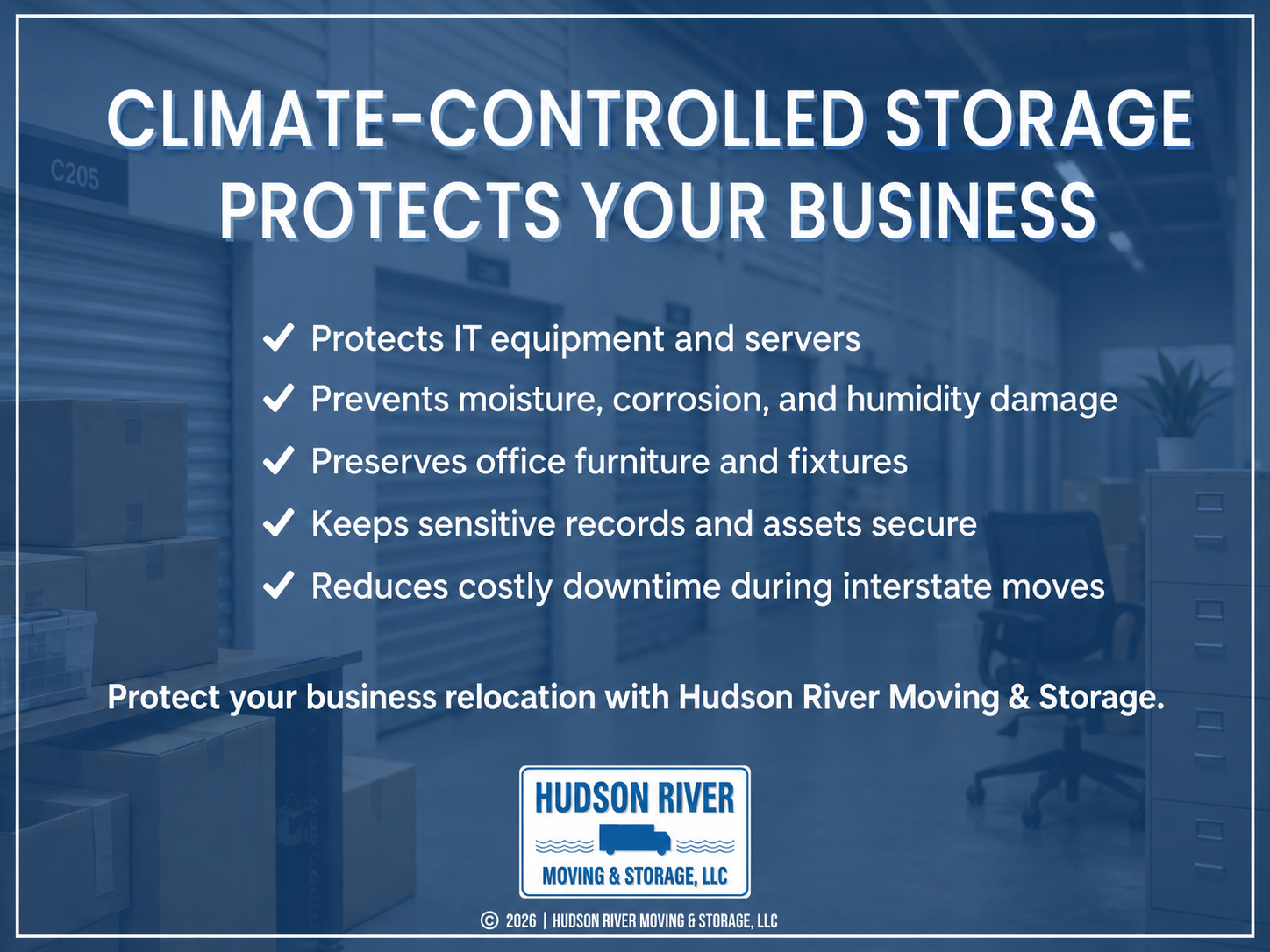
Climate-controlled storage maintains precise environmental parameters—typically a 55-85°F temperature range and 30-50% relative humidity—throughout the storage period. Unlike standard warehouse space, where conditions fluctuate with outdoor weather, climate control creates a stable microenvironment that prevents the expansion, contraction, and moisture damage that destroy sensitive assets.
For state-to-state commercial moves, this distinction matters more than most businesses realize. A local NYC office relocation might be completed in 24-48 hours, minimizing exposure to environmental extremes. State-to-state projects often span 2-3 weeks between your departure from the original location and full operational status at the new site. During this window, your assets sit vulnerable to whatever conditions exist in transit vehicles and temporary storage facilities.
Key differences between standard and climate-controlled storage:
- Temperature stability: Climate-controlled facilities actively heat or cool to maintain consistent conditions regardless of external weather.
- Humidity management: Dehumidification systems prevent moisture accumulation that leads to mold, warping, and electronic corrosion.
- Air quality: Filtered air circulation reduces dust and particulate contamination.
- Monitoring systems: Real-time sensors track conditions and trigger alerts if parameters drift outside acceptable ranges.
- Insurance and liability: Many cargo policies require climate control for high-value equipment, making it a contractual necessity rather than an option.
The Hudson River Moving & Storage project management process includes climate risk assessment during the initial walk-through. Our project managers identify which assets require environmental protection, calculate storage duration based on your timeline, and build protection protocols into the move plan—not as an afterthought, but as a foundational component of the relocation strategy.
Why Your Commercial Assets Need Climate-Protected Storage Solutions During Interstate Moves
Temperature and humidity fluctuations cause physical and chemical changes in materials that range from cosmetic degradation to complete equipment failure. Understanding which assets face the greatest risk helps you allocate resources appropriately and avoid the "penny-wise, pound-foolish" trap of economizing on environmental protection.
Technology and IT Equipment
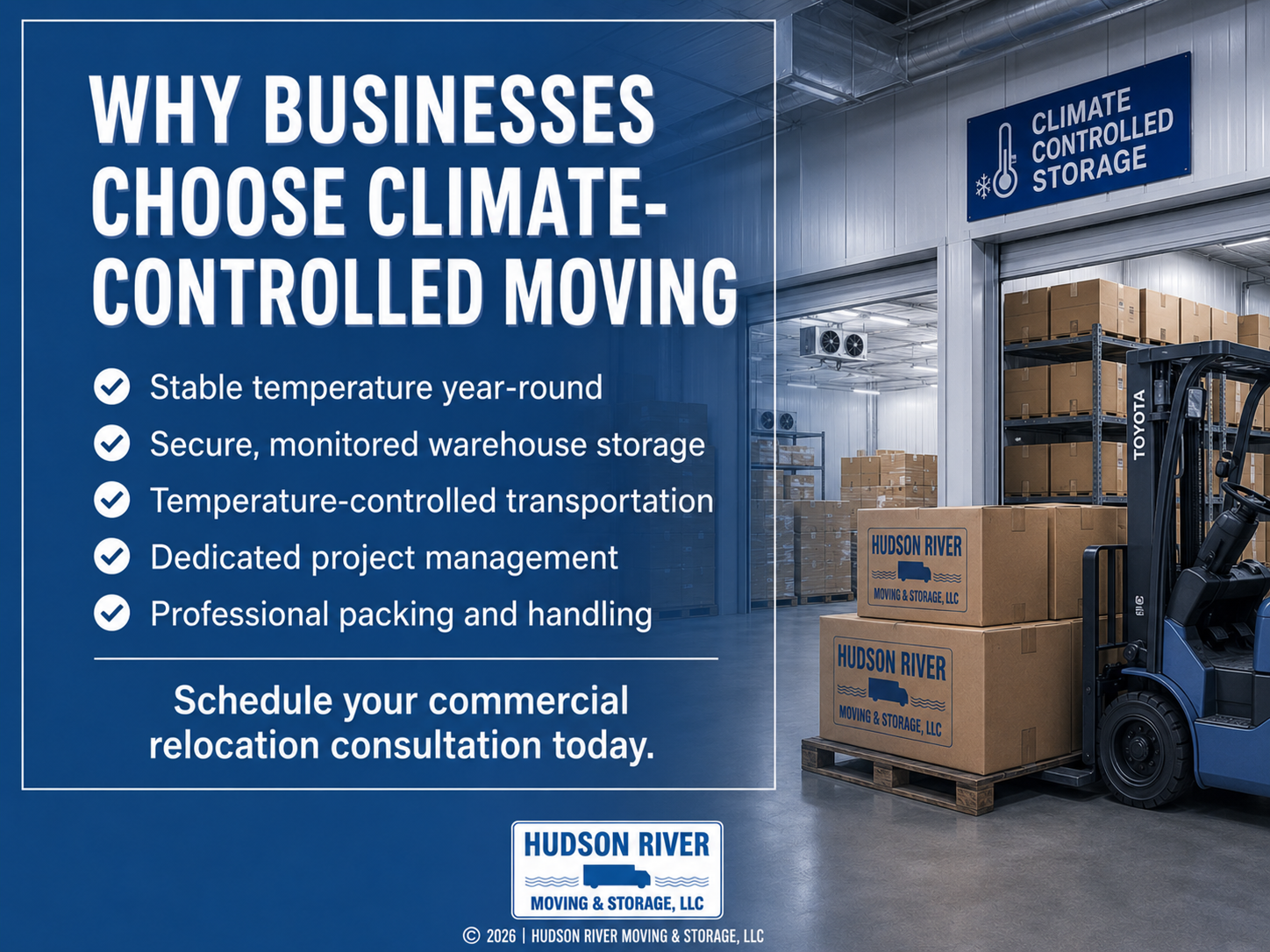
Server equipment, networking hardware, desktop computers, and audiovisual systems contain electronic components engineered to operate within narrow environmental parameters. Take them outside those parameters during storage or transit, and you trigger failure modes that may not manifest immediately—but will surface days or weeks after installation at your new location.
Condensation poses the primary threat. When equipment moves from a cool environment to a warmer one, moisture condenses on circuit boards, connectors, and internal components. This moisture creates electrical pathways where none should exist, causing short circuits, corrosion, and data corruption. A server that endures uncontrolled storage during a summer move from New York to Texas may power on successfully at the new data center, then fail catastrophically 48 hours later as corrosion progresses through vital circuits.
The Hudson River Moving & Storage end-to-end IT relocation process includes climate-controlled storage as a standard component. We disconnect equipment at your original location, pack it with moisture-resistant materials, transport it in temperature-controlled vehicles, and stage it in our climate-controlled warehouse in Secaucus, NJ. When we reconnect systems at your destination, they're in the same environmental condition as when we packed them—not degraded by weeks of exposure to uncontrolled conditions.
Office Furniture, Fixtures, and Equipment
Wood furniture responds to humidity changes by expanding and contracting. High-end conference tables, executive desks, and millwork installations contain wood joined with precision tolerances measured in thousandths of an inch. Store these pieces in a humid environment, and the wood swells, joints separate, and finishes crack. Store them in excessively dry conditions, and gaps open between panels as the wood shrinks.
Leather upholstery and fabric panels face similar risks. Mold grows in damp conditions, creating permanent staining and odor that renders expensive seating unsalvageable. Metal components—filing cabinets, chair frames, desk bases—develop surface rust when humidity exceeds safe levels, especially if they're stored near coastal areas where salt-laden air accelerates corrosion.
The typical state-to-state commercial relocation involves FF&E worth $250,000-$2 million. Companies that have invested in Herman Miller systems, furniture, custom millwork, or imported conference room installations cannot afford to treat these assets as disposable. Climate-controlled storage preserves the physical integrity and aesthetic quality that justified the original investment.
Sensitive Documents and Records
Despite digital transformation initiatives, most organizations still maintain physical records for legal, regulatory, or operational reasons. Financial institutions need loan documentation, healthcare providers store patient files, law firms maintain case records, and real estate companies preserve transaction histories. Paper degrades rapidly in non-climate-controlled environments.
High humidity causes paper to absorb moisture, leading to expansion, cockling, and mold growth. Documents stick together, ink bleeds, and structural integrity fails to the point where individual sheets tear when handled. Low humidity makes paper brittle, causing similar handling damage through a different mechanism.
Compliance and legal requirements often mandate specific storage conditions for records. The SEC requires broker-dealers to maintain certain records "in an accessible place" under conditions that prevent deterioration. Similar rules apply across healthcare, legal, and financial services. Moving these records across state lines without climate-controlled storage may constitute a regulatory violation, exposing your company to penalties that dwarf the cost of proper environmental protection.
How Hudson River Moving & Storage Protects Your Assets Across State Lines
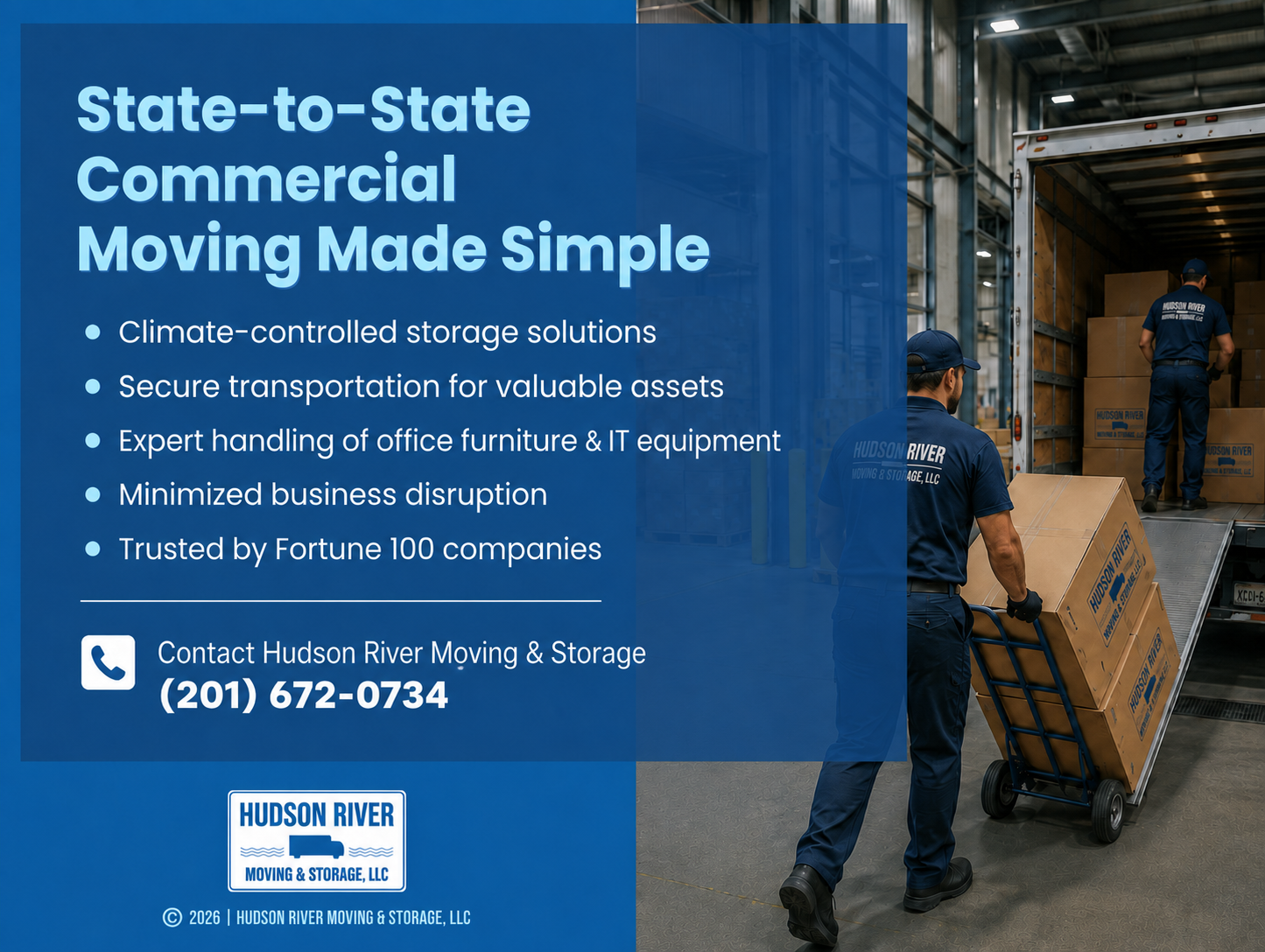
The dedicated project manager model distinguishes Hudson River Moving & Storage from competitors who treat commercial relocations as logistics problems rather than operational transitions. Your project manager owns the climate protection strategy from initial assessment through final installation, coordinating with your facilities team, IT department, and real estate advisors to ensure environmental risks never compromise your timeline or budget.
Step 1: Pre-Move Climate Assessment
Before we pack a single box, your project manager conducts an inventory walk-through focused on environmental risk. We identify temperature-sensitive equipment, humidity-vulnerable materials, and assets with specific storage requirements documented in manufacturer specifications or insurance policies.
This assessment produces a climate risk matrix that categorizes assets into protection tiers:
- Tier 1 (Critical): Equipment requiring strict environmental control throughout transit and storage—servers, networking hardware, sensitive electronics
- Tier 2 (High): Assets vulnerable to moderate climate variations—fine furniture, leather goods, wood installations
- Tier 3 (Standard): Items tolerant of normal environmental fluctuations—basic office furniture, non-electronic supplies
Your project manager uses this matrix to build protection protocols and allocate warehouse space. Tier 1 assets receive priority placement in our climate-controlled facility with continuous monitoring. Tier 2 assets go into climate-controlled storage with standard monitoring intervals. Tier 3 assets may use standard warehouse space if your budget requires optimization—but only after explicit discussion and approval.
The assessment also identifies timing risks. A move scheduled during summer months faces different challenges than a winter relocation. New York to Florida summer moves mean assets transition from air-conditioned environments to extreme heat and humidity. Our project managers factor seasonal considerations into packing specifications and transportation scheduling.
Step 2: Specialized Packing and Protection
Climate protection starts with how we pack your assets. Standard cardboard boxes and bubble wrap provide mechanical protection but offer minimal environmental shielding. Our commercial moving and storage protocols use climate-appropriate materials that create environmental buffers:
- Moisture barrier packaging: Electronic equipment receives multi-layer wrapping with desiccant packets that absorb ambient moisture. These packets continue working throughout storage, maintaining dry conditions inside the package even if external humidity fluctuates.
- Breathable covers: Wood furniture gets wrapped in materials that allow air circulation while blocking moisture accumulation. Non-breathable plastic creates condensation traps that accelerate damage rather than prevent it.
- Custom crating: High-value items—art, antiques, specialized equipment—receive custom-built crates with integrated climate barriers. These crates include insulation layers that buffer temperature changes and moisture barriers that maintain stable internal conditions.
- Labeling systems: Every package receives labeling that identifies contents, destination location, and climate requirements. When assets arrive at our Secaucus, NJ, facility, warehouse staff route them to appropriate storage zones based on these labels, ensuring nothing sits in the wrong environment.
Step 3: Monitored Transit and Storage
Temperature-controlled transportation extends climate protection from your original office through transit to our warehouse facility. Our commercial moving company fleet includes vehicles with integrated climate systems that maintain stable conditions during long-haul moves. Real-time monitoring tracks internal conditions and alerts our dispatch team if temperatures drift outside acceptable ranges.
Upon arrival at our climate-controlled warehouse, assets move directly into staging areas matched to their protection tier. The facility maintains 24/7 environmental monitoring with automated systems that track temperature, humidity, and air quality. Any deviation from target parameters triggers immediate alerts to facility management and your project manager.
We provide documentation of storage conditions for insurance and compliance purposes. Financial services clients often need this documentation for regulatory filings. Technology companies want proof that equipment remained within manufacturer specifications during storage. Healthcare organizations require evidence of proper handling for sensitive devices. Your project manager coordinates this documentation and includes it in the post-move close-out package.
Protect Your Commercial Relocation With Climate-Controlled Storage
State-to-state business moves involve more than transportation—they require careful coordination, environmental protection, and operational planning. Hudson River Moving & Storage provides climate-controlled moving and storage solutions designed to safeguard sensitive IT equipment, office furniture, records, and high-value assets throughout every phase of your relocation.
With over 100,000 square feet of secure warehouse space in Secaucus, NJ, dedicated project management, and experience supporting Fortune 100 companies across the Tri-State Area, our team helps businesses relocate with minimal disruption and greater peace of mind.
Whether you are planning an office relocation, IT infrastructure move, FF&E installation project, or temporary storage solution, Hudson River Moving & Storage can help you build a strategy that protects your assets from pickup through final installation.
Request a quote today or schedule a walkthrough with our commercial moving team to discuss your upcoming interstate relocation needs. Call (201) 672-0734 or visit HudsonRiverMoving.com to learn more about our climate-controlled commercial moving and storage services.